Writing · · 7 min read
The laptop was the vault
Binance lost about $6.3 billion on 29 October 2026 and says no private key leaked: a compromised engineer’s laptop reached the service that asks the wallet for money. Bybit’s record theft in 2025 started on one developer’s Mac. The most valuable computer in your company is no longer in the locked room.
By Liju Abdul Karim, Founder & MD, BRev Digital, Dubai
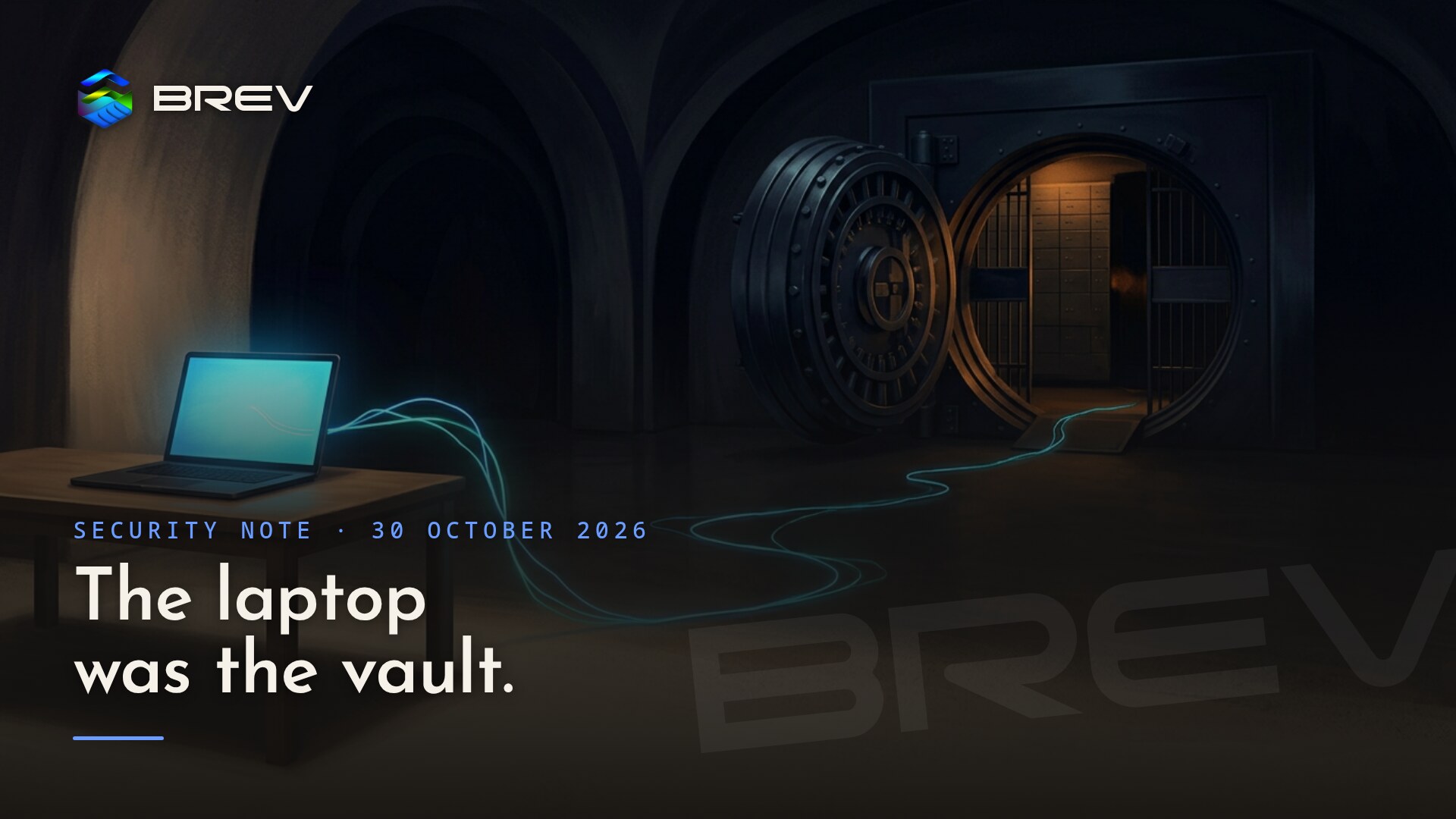
Late on Thursday 29 October, about $6.3 billion left the hot wallets of the world’s largest crypto exchange in a few hours. By Friday morning Binance had frozen roughly $3 billion of it with the help of the stablecoin issuers, promised to cover every user from its own funds, and published its first finding. It was not a stolen key. In Binance’s words, the incident “may involve a compromised DevOps engineer’s laptop, which allowed an attacker to gain access to a service container and submit unauthorized withdrawal transactions.” And then the sentence that matters most: “We have found no evidence of any wallet private key leak.”
I have spent twenty years on the infrastructure side of IT, and that sentence is the whole story. The vault held. The laptop was the vault.
What we know, and what is still Binance’s guess
The on-chain half is clear because it is public. Blockaid traced the first move to a single Ethereum transaction at 20:20 UTC carrying fifty authorisations under EIP-7702, the rule that lets an ordinary account hand its execution to a contract. Each authorisation only works if it matches the account’s current nonce, the counter that ticks with every transaction, and Binance’s hot wallet was busy paying out withdrawals, so the attacker could not know the number. They guessed fifty in a row. One matched. That one pointed the wallet at a contract with a sweep function, and about four minutes later roughly $2.5 billion had gone from that wallet alone, including 167,464 ETH. Other wallets followed on Ethereum, Bitcoin, Tron, Arbitrum and Avalanche.
The off-chain half is Binance’s hypothesis, and it says so. A compromised laptop, a service container that is allowed to ask the wallet for a withdrawal, and withdrawals that the system treated as legitimate. What it has not yet explained is how the attacker obtained the signed authorisations. That is the question the promised post-mortem has to answer. Until it does, hold the laptop story the way Binance holds it: likely, not proven.
What is not in doubt is who the analysts think did it. TRM Labs says North Korea’s TraderTraitor unit, with high confidence. ZachXBT says Lazarus. Binance has named nobody and says it is working with law enforcement. For scale, TRM Labs counted $2.9 billion stolen across nearly 150 crypto attacks in the whole of 2025. If Binance’s number holds, one night in October took more than twice that year.
Bybit was the rehearsal
The previous record was Bybit, in February 2025, and it is worth reading the two side by side because they are the same incident with different nouns. On 4 February a developer at Safe{Wallet}, the multi-signature wallet Bybit used for cold storage, ran a Python project with some Docker logic on his Mac. It talked to a domain the attacker had registered two days earlier. From 5 February the attacker was inside Safe’s AWS account on that developer’s live session tokens. They tried to register their own MFA device and failed, so they simply kept using his sessions, for two weeks, while they mapped the environment.
On 19 February a few lines of JavaScript appeared in the Safe{Wallet} front end served from AWS. On 21 February Bybit’s signers approved what looked like a routine cold-to-hot transfer. The page they were looking at had swapped the destination. About 400,000 ETH, roughly $1.5 billion, left in one signed transaction, and the script was scrubbed minutes later. Safe’s own review found no vulnerability in its contracts or its front-end code. The attack, it said, was “achieved through a compromised Safe{Wallet}developer machine.” The FBI attributed it to the same North Korean unit.
No key leaked then either. The machine trusted to serve the signing page, and the people trusted to sign, were enough.
The server is now the laptop
My first job was application and network support at Saint-Gobain in Andheri, Mumbai. The things that mattered lived in a locked room: the domain controllers, the RSA server that issued the sign-in tokens, the NAS with everyone’s files. The laptops were the cheap part. If one was lost, you re-imaged it.
That picture is twenty years out of date and most organisations still run on it. Open a developer’s laptop today and count what is on it: a cloud session that can reach production, SSH keys, a package-publishing token, the sign-in files of three AI coding tools, a Docker socket, and a browser that is logged in to everything. That machine has more reach than the locked room ever had, and it travels, sleeps in cafés, and runs code the owner did not write several times a day. The year’s other big campaigns knew this. The npm worms and the GhostAction attacks of 2025 and 2026 were built to pull exactly these things off exactly these machines. North Korea’s unit just aimed the same idea at the two laptops in the world with the most money behind them.
What I would change by Monday
- Treat every developer laptop as production. Full-disk encryption, automatic patching, endpoint detection, and an inventory that says which machine can reach which internal service. If you cannot list them, you cannot defend them.
- Make sessions short and bound. Cloud and admin sessions should die in hours, be tied to the device, and ask for a fresh second factor before anything privileged. Bybit’s attacker rode one developer’s sessions for seventeen days.
- Put a second human on a second device in front of money. Withdrawals, releases, and any change to who may approve them. One compromised machine must never be one approval.
- Never run a stranger’s project on the machine that holds your sessions. The interview task, the “can you test my Docker setup” favour, the sample repository: a disposable VM with nothing on it. This was Bybit’s front door.
- Give the services that can ask for money their own identity, and watch who calls them. A withdrawal service called from an engineer’s laptop should page someone, not pay someone.
- Hold new packages back and turn install scripts off, so a poisoned dependency cannot plant a credential stealer the moment it installs.
- Give AI coding agents their own scoped credentials, never a person’s login, and keep them off the machine that can approve a withdrawal or a release. I build these agents for a living, and this is the rule I hold mine to.
Binance will publish its post-mortem, Safe published its, and both will be read mostly by people in crypto. That is a waste. The lesson is not about exchanges. It is that the most valuable computer in your company is no longer in the locked room. It is on someone’s kitchen table, and it has been for years.
The full timeline, the freeze figures by issuer and the checklist with sources are on the BRev site: brevdigital.com/guides/binance-hack-developer-laptop.
Sources
- CoinDesk: Binance loses over $6 billion in the largest crypto hack to date (Binance’s statement, issuer freezes, SAFU)
- CoinDesk: the 18,270 BTC in 19 wallets, and TRM Labs’ attribution
- crypto.news: Blockaid’s analysis of the 50 EIP-7702 authorisations
- CyberInsider: Binance links the incident to a compromised laptop (the 30 October statement)
- France 24: Binance security breach has $6.3 billion impact (market reaction; TRM Labs’ 2025 total)
- Safe Ecosystem Foundation: statement on the Bybit incident
- Elastic Security Labs: Bit ByBit, the dated timeline of the 2025 theft